The Slow Mirror: Why One Honest Look Before You Leave the House Beats a Hundred Outfit Pics
There's a moment happening in bathrooms and bedrooms across America every single morning, and most of us don't even notice we're doing it anymore. It's the half-second glance-capture-pose-repeat cycle — the outfit photo taken before the coffee is even finished, the quick tilt of the head to check how something reads on camera rather than how it feels on the body.
We've become fluent in a new visual language: the language of being seen. And somewhere in that fluency, we lost something quieter. Something that used to happen between a woman and her reflection that had nothing to do with an audience.
I've started calling it the slow mirror. And I think it might be the antidote to the way we get dressed in 2025.
What the Camera Took From Us
Let's be honest about what changed. Getting dressed used to be a private negotiation — between your mood, your plans, your body that day, and the clothes hanging in your closet. Now there's a third party in the room, and it has a lens.
Research on selfie behavior has been telling us for years what we already intuitively know: photographing ourselves shifts us into evaluation mode. We stop wearing the outfit and start assessing it. Does this angle work? Would this read well on the grid? Is this giving what I want it to give?
That's not style. That's performance review.
And the cruel irony? The outfits that photograph beautifully are not always the ones that live beautifully. The stiff blazer that looks sharp in a mirror selfie might dig into your shoulders by 2 p.m. The viral dress that flatters at a 45-degree angle might make sitting through a work lunch feel like a hostage situation. The camera doesn't know about your commute, your afternoon slump, or the way you gesture with your hands when you're excited.
The Slow Mirror, Defined
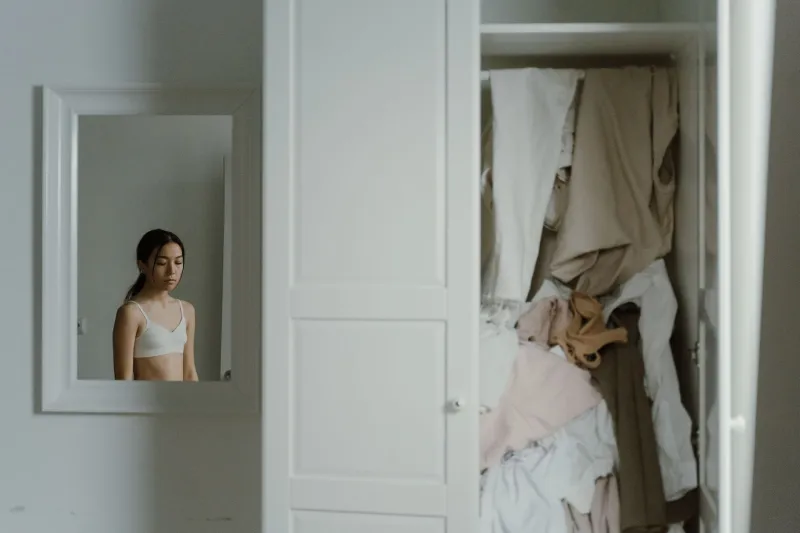
The slow mirror is simple: one unhurried, judgment-free look at yourself before you walk out the door. Not a photo. Not a pose. Not a scroll back through the shots to pick the best one.
Just... a look. Eyes up, full length if you can manage it, and — this is the hard part — without the critique running in the background.
Think of it like slow food for your reflection. You're not grabbing a snapshot on the way out. You're actually tasting the moment. How do I feel in this? Where am I going? Does this outfit match the life I'm about to have today?
It takes maybe thirty seconds. But those thirty seconds change the entire relationship you have with what you're wearing.
Why Judgment-Free Is the Key Phrase
Here's where I have to be honest, because a slow mirror without the judgment-free part is just... standing in front of a mirror feeling bad. We've all done that. It's not a practice, it's a punishment.
The point isn't to scrutinize. The point is to witness. There's a difference between looking at yourself to find flaws and looking at yourself to make contact. One is an interrogation. The other is a check-in with someone you're going to spend all day with.
Try this: instead of asking "do I look good?" — a question with no bottom — ask "does this feel like me today?" Some days the answer is a polished yes. Some days it's leggings and a hoodie and a yes of a completely different flavor. Both count. Both are honest.
A Small Protest Against Hyper-Documentation
I don't think anyone needs to quit taking outfit photos. Honestly, I love a good fit pic — they're a record of your style evolution, a little visual diary. But there's a difference between documenting your style and outsourcing your self-perception to a camera.
When every outfit exists primarily to be captured, you start dressing for a version of yourself that lives in a two-dimensional rectangle. Real life is three-dimensional. It's motion, weather, fluorescent office lighting, the hug from a friend that wrinkles your silk shirt. The slow mirror brings you back to that dimension — the one where you actually spend your time.
It's also, quietly, a privacy thing. Not every look needs to be content. Some of the best outfits I've ever worn were seen by exactly three people and a barista, and they were great because nobody was grading them.
How to Build the Habit
If you want to try it, keep it low-stakes:
- Pick one mirror moment a day. Morning is ideal, but the point is that it's unhurried. Before bed works too.
- Leave the phone in another room. This one's non-negotiable. The camera can't be in the room for this practice.
- Ask one question, not fifty. "Does this feel like me today?" is plenty.
- Notice one thing you like. Not as a forced affirmation — just as a matter of accuracy. There's always something: a color, a drape, the way a sleeve hits.
That's it. No journaling, no thirty-day challenge, no before-and-after. Just a daily appointment with yourself that no one else gets to attend.
The Look That Actually Lasts
Here's what I've noticed since making this a habit: I second-guess my outfits less. When you've made one honest assessment in the morning — from your own eyes, not a lens — you stop running the evaluation on a loop all day. The outfit is decided. You're free to go live in it.
And isn't that the whole point? Clothes are supposed to carry you through your life, not the other way around. A hundred outfit pics can't give you that. One slow mirror can.
So tomorrow morning, before the day grabs you — take the look. The real one. It's the only reflection that's actually for you.