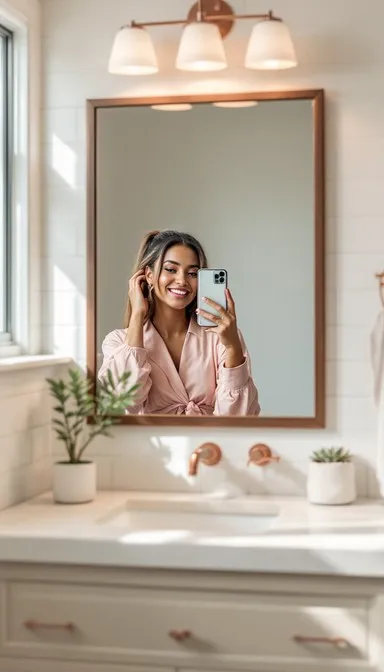
Dressed for Nobody But You: Why Your At-Home Style Deserves More Intention
Photo: Shixart1985, CC BY 2.0, via Wikimedia Commons
Here's a question worth sitting with: What do you actually wear on a Tuesday when you have nowhere to be?
Not the outfit you'd grab for a coffee run where you might run into someone. Not the work-from-home blazer you throw on for Zoom calls. I mean the real Tuesday — the one where the only witnesses are your houseplants and maybe a pet who couldn't care less.
If your honest answer involves a pair of stretched-out leggings from 2017 and a college sweatshirt with a mystery stain, you're not alone. But here's the thing most of us don't talk about: those private style choices? They matter. Maybe more than anything you'd ever post to Instagram.
The Mirror Effect Nobody Talks About
There's a concept in psychology called enclothed cognition — the idea that what we wear doesn't just signal something to the world, it actually changes how we think and feel about ourselves. Studies have shown that people who dress more intentionally report higher levels of confidence and focus, even in low-stakes environments. But the fashion world tends to apply this idea almost exclusively to public dressing. We talk endlessly about what to wear to a job interview, a first date, a dinner party.
We almost never talk about what to wear to a solo Saturday.
And that's a gap worth closing. Because if the clothes you put on genuinely influence your inner state, then the outfits you wear most — the ones you slip into at home, alone, day after day — are quietly doing a lot of psychological work. They're either building something up or slowly chipping away at it.
What Your Loungewear Is Actually Saying
I'm not here to shame anyone's sweats. Comfort is real, it's valid, and frankly, the loungewear industry exists for a reason. But there's a difference between choosing something cozy because it makes you feel good, and defaulting to something worn and shapeless because you've mentally written off the day before it even starts.
One is self-care. The other is self-abandonment dressed up as relaxation.
When you consistently reach for the most defeated version of your wardrobe on your quietest days, you're sending yourself a message — whether you mean to or not. That message is something like: I'm only worth the effort when someone else might see me. And that's a belief system worth interrogating.
Think about how you feel on a day when you've pulled on a soft matching set, maybe lit a candle, made your bed. Now compare that to a day where you shuffled through in whatever was closest to the bedroom door. The circumstances might be identical, but the internal experience usually isn't.
Building a Private Wardrobe Worth Having
So what does intentional at-home dressing actually look like? It doesn't mean getting dressed up to watch Netflix. It means curating your private wardrobe with the same care you'd give the rest of your closet.
Start with fit. The number one thing that separates "cozy" from "defeated" is whether something actually fits your body. Oversized can be intentional and chic. Shapeless and ill-fitting is a different energy entirely. If your loungewear doesn't feel good on your body, it's not actually doing the comfort job you think it is.
Think in palettes. You don't need to match perfectly at home, but having loungewear that feels cohesive — colors you actually like, fabrics that feel like a treat — makes the act of getting dressed feel like something you're doing for yourself rather than just going through the motions.
Retire the guilt pieces. You know the ones. The promotional T-shirt you kept because it felt wasteful to toss, the pajama pants with the broken drawstring, the hoodie that's technically wearable but makes you feel invisible. If something doesn't make you feel at least neutral when you put it on, it's not earning its place in your space.
Create a morning ritual that includes getting dressed. Even on days with no plans. This doesn't have to be elaborate — it can be as simple as washing your face, putting on a real outfit (even if that outfit is elevated loungewear), and making a cup of coffee before sitting down to whatever the day holds. That small act of intention sets a tone that tends to ripple outward.
The Days Nobody Sees Are the Most Formative
Here's what I keep coming back to: the version of yourself you inhabit most is the private one. The one between the events, the plans, the appearances. That version spends more time in your skin than any curated, public-facing self ever will.
If you're only dressing with care and intention for the moments that might be photographed or witnessed, you're essentially decorating the front porch while the rest of the house falls apart. The interior matters. The everyday matters.
This isn't about aesthetics for aesthetics' sake. It's about the quiet act of saying I'm worth the effort today — even when today looks like working from the couch, doing laundry, and watching whatever's been sitting in your streaming queue for three weeks.
A Small Shift With a Surprisingly Big Payoff
You don't have to overhaul anything. You don't need to invest in a full at-home wardrobe or suddenly start getting dressed like you're expecting company. But I'd encourage you to try one small experiment: for one week, make one conscious choice about what you wear at home each morning. Just one. A pair of lounge pants that actually fits. A soft top in a color you love. Slippers that feel like an indulgence rather than an afterthought.
Notice how it shifts things. Not dramatically — this isn't magic. But subtly, in the way that matters most. In how you move through your own space. In how you talk to yourself throughout the day. In how much energy you have left for the things that actually fill you up.
Personal style has always been sold to us as a public language — something we use to communicate with the world. But at its best, it's a private one. A conversation between you and yourself, held every single morning, regardless of who's watching.
Make that conversation a good one.